
October 23, 2026
I Have No Words to Describe How I Feel, and That’s Okay.
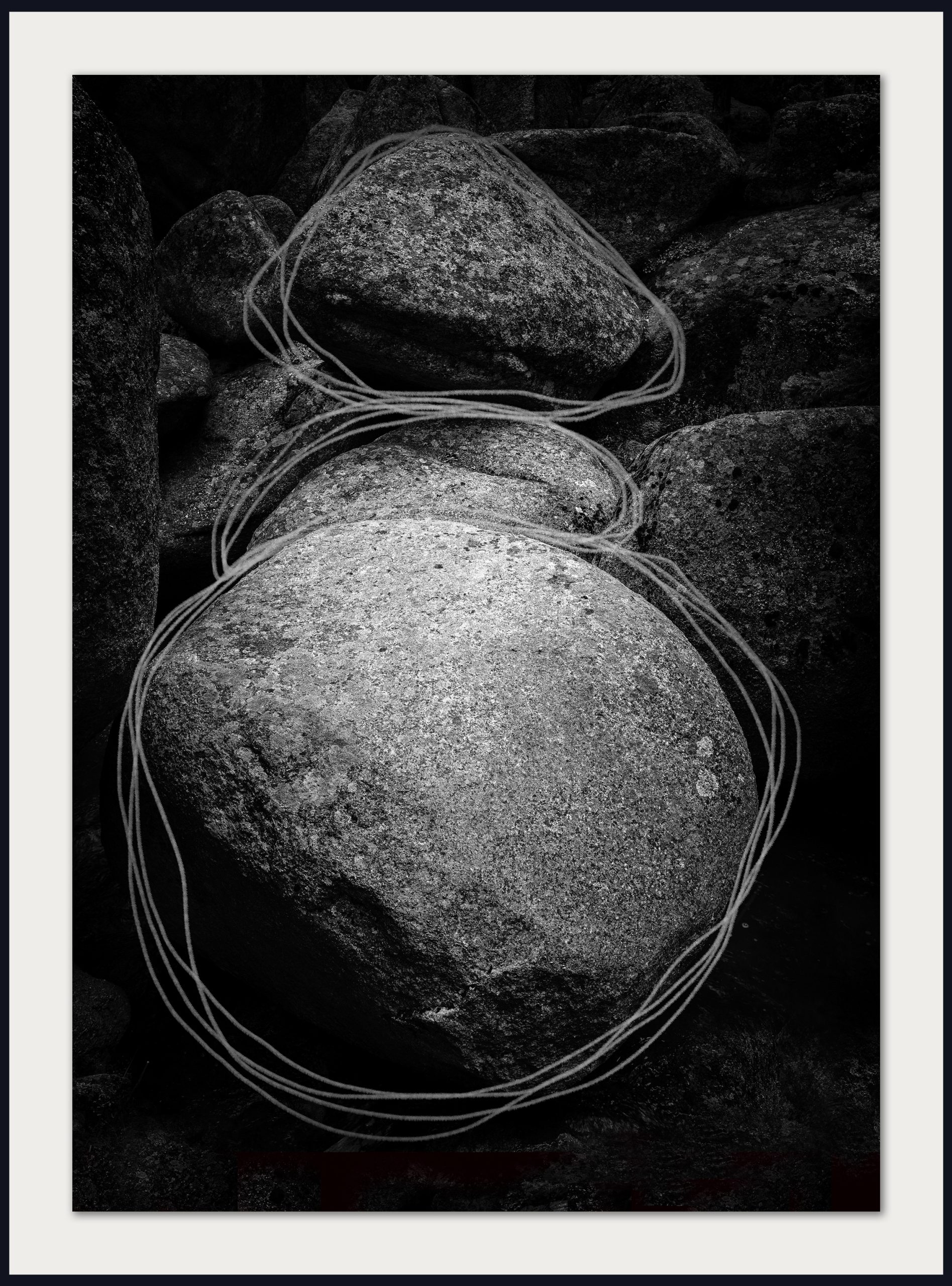
Wireloop by Rita Swinford
At the last Vision Retreat that we held at my home, a friend and participant, Rita Swinford, created this image. I was immediately drawn to it and could not stop looking at it. I put the print up on the wall in my office and study it often. Now here’s the interesting thing: all I can say about the image is “I love it!”
I cannot tell you why I love it.
I cannot tell you how it makes me feel.
I cannot tell you what it means to me.
I’ve always felt bad that I don’t have words to describe such things. Especially when I’m around people who have that ability in abundance, such as Brooks Jensen and Beth Buelow. I admire people who can talk about what their photographs mean, how they felt, and what they were saying.
I cannot, and that’s okay. I am a simple person and I believe one of the reasons photography appeals to me, is that I don’t need to use words…I can use my images. If a picture is worth a thousand words, why then should I need to describe it? What do you see? How does it make you feel?
I once looked at someone’s photograph and said “I love it!” and they responded that my comment was just a cop-out. They felt that unless I could tell them why I loved it with words, it was just an insincere compliment. But I disagree, for me “I love it!” is the highest compliment I can give or hope to receive.
I love Rita’s Wireloop image, and I cannot tell you why, but I love it!

Please remember that the Nature Photo Summit is coming up on November 6-8. It is free for those three days, but you must register to view the presentations. If you’d like to view the 22 different presentations after those three days, you can do so for a small fee. But either way, you must register!


And I love this. I have felt this way for so long. I have felt like I had a block whereby the correct word to express my why wasn’t available. Thankyou for this.
I feel the same way, Cole. I’m struck by an image but having to explain “why” takes away from the “feeling”. I listen to critiques (not my images) and the person will say “That’s a great image. “This line takes me to this rock and the clouds swirl my eyes around the sky etc etc”. I don’t look at images that way. Is that bad?
I agree with you, I started to say why, but realized I was doing the same thing by trying to put into words why I agree. As John would say, does it “…make your heart sing?”, Good enough for me!
Um, you had to bring “him” up???
I have no words…
Agreed! But perhaps there are two separate topics here? Topic 1- why I like your image. Topic 2- why I clicked the shutter and what I was chasing when I made the image?
Another great post, Cole and I react to this image as you do. I often react to paintings the same way. The Rothko’s Seagram series brings me to tears but I have no idea why. Does it even matter?
Coincidentally, I’m writing a Substack post on the value of photographs: why a very mediocre photograph by a “big name” can sell for thousands of dollars, yet a remarkable photograph by Rita Swinford is ignored.
Do you think Rita would let me use this image as an example? How can I contact her?
Email me and I will give you her email address.
I am the exact opposite, Cole. When I have strong feelings about an image — positive or negative — it forces me analyze why I feel that way. I can only do that by putting my feelings into words.
We are all different Hal!
But a question for you: what if you had been born without the ability to hear or speak, would you not be able to enjoy art?
It’s 100% okay! I guess folks like me and Brooks, we’re word nerds… it’s part of how we experience art. That said, I have times when words escape me, and all that’s left is “I love it, don’t know why, don’t need to know why.”
I feel tension, though, because I do believe there are times when it’s valuable to be able to articulate the why. But sitting here thinking about it, I feel the need to go further and consider exactly when and why it’s valuable. It’s like matryoshka dolls!
Thanks for putting yet another deep philosophical question into my already-busy brain :-).
You and Hal both!
It’s good that there are different ways to appreciate art and beauty.
Cole, Another good topic you bring up. Back in the day when viewing photographs were done in a gallery with proper lighting, I experience this same emotion many times. The first time I saw Edwards Pepper #30, I could stop looking at it. Same thing Dorothea Lange’s migrant mother image. Exceptional photographs are rare, and don’t need words to explain them
When you tell someone, “I love you”, you cannot always define why you love them. It is an indescribable feeling of pure emotion that is the result of many attributes and events. Art, being subjective, is the same. It is misguided to ask someone why they love a person or a thing when that “feeling” didn’t derive from the logical mind, but from the subjective mind where feelings come from.
I’m going to share your comment with my wife, who is always asking me “why do you love me?“
As one who, from time to time, also asks that question of my partner, I am asking him what qualities he notices about me that contribute to his feelings of love or affection. And really, I am asking to see what he sees that I cannot see about myself. It can be very wonderfully affirming for me when he indulges me in this way.
I appreciate your comment, Russ, because it made me reflect on my experience. I hope it’s okay to share: This summer for my husband’s 65th birthday, I gave him a card that listed 65 reasons why I love him. Making the list was for both of us. For me, it gave me the opportunity to think of and be grateful for his wonderful qualities and quirks. For him, he felt seen, and for a guy who wants for nothing but doesn’t always feel seen by others, that was the best gift I could think of.
Of course, there are many ways to “see” someone (or art) that don’t involve words. Maybe in our case, after almost 29 years of marriage, words are part of what sustains the love. Everyone’s recipe is different.
I’m not sure how that applies to art for me, except that being able to name some of what I love about a piece often deepens my appreciation for it and tells me something about how I relate to the world.
I must agree with you. Looking at images I cannot say I always go back to the same images at the art museum before going through the rest of the museum to see something new. But I am a person of few words. I will look at a painting or other work of art for 15-20 minutes with out any thought coming into my head. Just letting it possess me..
First time I saw Salgado’s images in person, I was in tears. No idea why. Saw that show multiple times (at the Photographic institute in NY?) and same reaction. Saw another of his series in Madrid a few years ago, and had little reaction at all.
Subject matter was very different, the first was mostly humans and the second only landscapes. All beautiful, but different reactions.
Welcome to my side, my friend! I always feel looked down upon by those who can write paragraphs or speak endlessly about how they were feeling, etc. I have long held that you don’t need words for a photograph or any other type of art, including music, to have meaning. If I like it, that’s good enough for me. If that’s too simplistic, well, as I always say, f-em if the cant’ take a joke.
The best images are those not easily understood or explained. This is one of them. It’s of the Minor White or Caponigro class. We don’t need to find the words to explain it; that’s the inherent beauty of photography.
Cole,
Are you mixing “words” with “idea”? You often have an idea, then photograph to that idea: the ghosts of auschwitz, melting giants, ukrainians with eyes shut, trees from a train. How do I know – you wrote it down in words. But I’m not disagreeing with the idea that no words is ok at times.
For much of my photography’s many years, I went out and photographed completely intuitively – as Brooks would say: “gathering assets”. In the last year, I’ve been diving deeply into finding the ideas that were behind my vision. Learning from that experience (and it continues) has given me more depth as an artist with grouping the images into more coherent portfolios supported with words. Still in progress and enjoying it.
Words: If you have them, use them!
I’m also one who can’t explain why I love certain photographs, whether they are mine or taken by others. I just know it when I feel it but I usually can’t explain what it is that draws me in. Like Cole’s photograph of a woman swimming, or Ansel Adams’s oak tree in a snow storm, or Sally Mann’s last photograph of her son standing naked in a river creating ripples with his hand. It’s just a feeling and for some photographs it never goes away. I wonder if I was able to and had to explain it to others if I would lose some of the feeling.
It’s easier for me to say why I don’t like a photograph than why I like one. Feelings have always been hard to express but technical aspects are easier. Technical aspects don’t make me jump up and down with joy but feelings do.
Great point! It is so easy for me to say why I don’t like something…
Good points Cole. Photography is a visual expression though whjen searching for photos I do have an ongoing narration in my mind. However my best photos happen when I simply see something I have to photograph without knowing why, without the inner narration, without any explanation about why a scene appeals to me. It just does and that’s so satisfying when the inner artist guides you.
There absolutely is a place for the people who can describe why they are moved to love ( or intensely dislike) an image, in my opinion, as long as this is not based around the technical qualities / camera settings / focus point of the particular image.
That type of critique is about guardrails and is not emotionally driven.
Being intrigued by an image, positively or negatively, comes from your own life experiences and is entirely personal.
I do not have the words to explain my reaction to the photographs that stop me in my tracks and trigger an emotional response, and I’m ok with that because (gratefully) I do not have a platform to express those opinions.
Thanks for giving voice to not necessarily having a voice Cole 🙂
I love this image too and I feel if I tried to explain why I wouldn’t be able to capture my immediate emotional response to it. Sometimes no words is the best.
Every person’s reaction to an image is based on the context of that person’s life experiences. Does it strike a chord? Is there a connection? No two are the same.
There is no good or bad reaction.
Totally with you Cole. Emotion is the ultimate guidance rather than paralytic analysis.
As an abstract painter I prefer not to explain or even give a straightforward title to my work. Like you IMHO, it’s the work that should have the conversation with the viewer.
Totally agree. I’m increasingly of the view that we live in a world where something has to have a purpose, is a simply a causal step to some greater good – visit museums or galleries to reduce stress, take yoga to aid balance to prolong life, eat this for that, learning a language can delay the onset of whatever, doing X will prolong your life…..and so on.
Why can’t we just do stuff because we enjoy it and love it? End of. No explanation needed.
Reading your last email about not describing why you like a photograph made me smile (and chuckle a bit.) I especially liked your observation, “If a picture is worth a thousand words, why then should I need to describe it? ” That is a quote I’m going to remember, and come back to.